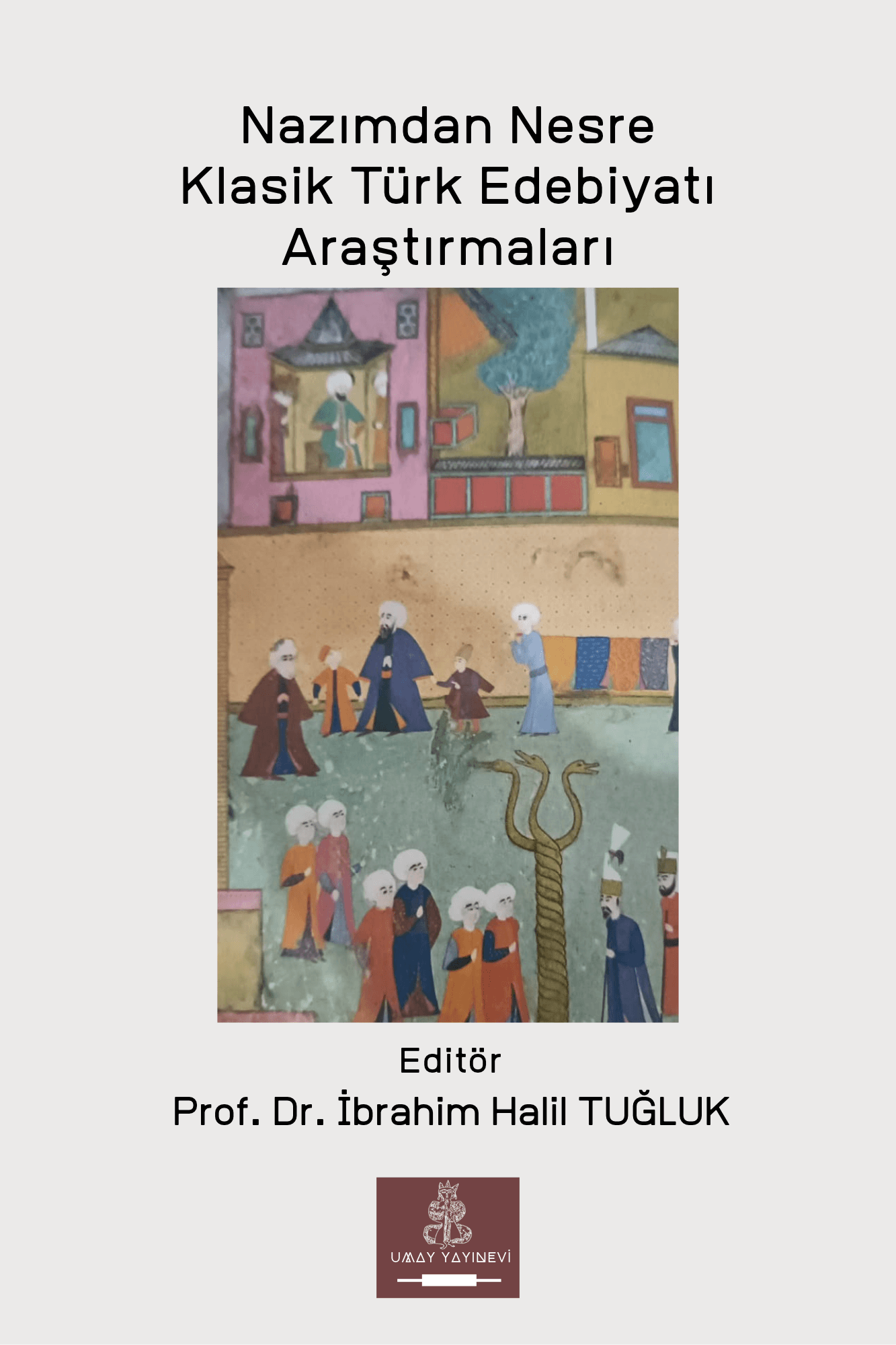
| Book Name / Yazar | Nazımdan Nesre Klasik Türk Edebiyatı Araştırmaları / Editör: İbrahim Halil Tuğluk |
| Publishing Year | 2026 / Umay Yayınevi |
| Number of Pages | 220 |
| Edition Number Location | 1st Edition |
| ISBN | 978-625-5036-14-8 |
| DOI | 10.5281/zenodo.23617536 |
| Language | Türkçe |
| Main Topics | Klasik Türk Edebiyatı, Nazım, Nesir, Gelenek, Tahlil |
| Atıf/Cite | Tuğluk, İ. H. (Ed.) (2026). Nazımdan nesre klasik Türk edebiyatı araştırmaları. Umay Yayınevi. |
Öz:
Nazım ve nesir, klasik gelenekte birbirini tamamlayan, Türkçenin tarihsel gelişimini izlememize imkân veren iki anlatım biçimidir. Nazım ve nesir, kendilerine özgü kuralların yanı sıra içinde geliştikleri ve karşılıklı etkileşimde bulundukları edebî çevre aracılığıyla birlikte dili, inancı, sosyal hayatı ve tefekkür dünyasını bize aktarmıştır. Metin neşri ve metin tahlili; yazma nüshaların tespitinden çeviri yazıya, titiz bir edisyon kritik çalışmasından metnin içinde adeta istif edilmiş olan malzemenin tespitine kadar uzanan ve büyük sabır, metanet ve dikkat gerektiren meşakkatli fakat bir o kadar da kıymetli bir faaliyettir. Kütüphane raflarında erbâbını bekleyen eserleri gün yüzüne çıkarmak ne kadar önemliyse, daha önce neşredilmiş metinleri yeni nüsha tanıklıkları doğrultusunda yeniden ele almak da o kadar hayatidir. Doğruluğu, yani kök metni sağlam kurulmamış metinler üzerine yapılacak her türlü edebî, tasavvufi ya da sosyolojik yorum, maalesef yanlış veya en azından eksik kalacaktır. Bu yüzden ilmî disiplinin temel taşı olan metin neşrinde kat edilecek daha çok mesafe olduğu gibi keşfedilmeyi bekleyen kaynaklar da mevcuttur. İşte bu akademik hassasiyetler çerçevesinde şekillenen ve on iki bölümden oluşan elinizdeki bu eser; nazımdan nesre uzanan çizgide özgün bir içeriğe sahiptir.
Abstract:
Poetry and prose are two forms of expression in the classical tradition that complement one another and allow us to trace the historical development of the Turkish language. In addition to their own distinct rules, poetry and prose—through the literary circles in which they developed and with which they interacted—have together conveyed to us the language, beliefs, social life, and world of thought of their time. Text publication and textual analysis—ranging from the identification of manuscript copies to the transcription of texts, and from meticulous critical editing to the identification of material seemingly buried within the text—is an arduous yet equally valuable endeavor that requires great patience, perseverance, and attention to detail. Just as it is important to bring to light the works awaiting scholars on library shelves, it is equally vital to reexamine previously published texts in light of new manuscript evidence. Any literary, Sufi, or sociological interpretation based on texts whose authenticity—that is, whose original source—has not been firmly established will, unfortunately, be incorrect or, at the very least, incomplete. For this reason, just as there is still a long way to go in the field of textual publication—the cornerstone of scholarly discipline—there are also sources waiting to be discovered. Shaped within this framework of academic rigor and comprising twelve chapters, the work you hold in your hands features original content spanning from poetry to prose.
CLICK HERE FOR THE COVER.
Click the button below for bibliographic records.
 EN
 TR