
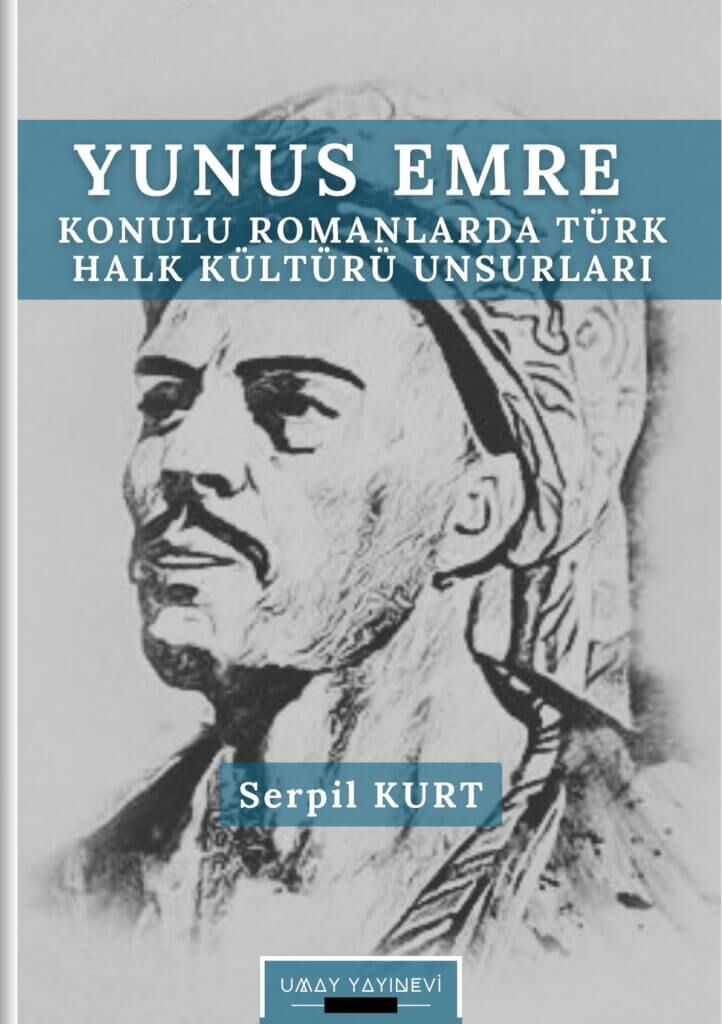
| Kitap Adı / Yazar | Yunus Emre Konulu Romanlarda Türk Halk Kültürü Unsurları / Serpil Kurt |
| Yayın Yılı | 2026 / Umay Yayınevi |
| Sayfa Sayısı | vii+338 |
| Baskı Sayısı / Yer | 1. Baskı / Samsun |
| ISBN | 978-625-93257-2-9 |
| DOI | https://doi.org/10.5281/zenodo.18841844 |
| Dil | Türkçe |
| Seri/Numara | 62 |
| Ana Konular | Yunus Emre, Roman, Halk Kültürü, Türk Halk Edebiyatı |
Öz:
Folklor/halk bilimi, halka ait olan her şeyi ele alan, bunları derleyen, sınıflandıran, çözümleyen ve yorumlayan bir bilimdir. Sosyal gelişmeler ve teknolojik ilerlemelere bağlı olarak folklorik ürünler de zamanla değişim ve dönüşüme uğrar. Halkın âdetleri, gelenek ve görenekleri bu yeni hayat tarzına göre şekillenir. Bir toplumun kültürel bilinçaltı hakkında yorum yapılabilmesi için geçmişten bugüne derlenen kültürel verilerin bir arada değerlendirilmesi gerekir. Folklor malzemelerinin edebî eserlerde -bu çerçevede romanlarda- yer alması, onların kaydedilmesi ve korunması açısından önemlidir. Kurguyu sağlam temele oturtmak amacıyla ve bir niyet doğrultusunda folklora başvuran yazar, dolaylı olarak halk kültürünü de sonraki nesillere aktarmış olur. Anadolu’nun Türkleşmesi ve İslamlaşmasında etkin rol almış olan bir edebî şahsiyet olarak Yunus Emre hakkında bugüne kadar on yedi roman yazılmıştır. Halk kültürü açısından kayda değer unsurlar barındıran bu romanlar, Yunus Emre’nin menkıbe ve şiirleri esas alınarak kurgulanmıştır. Bu çalışmada Yunus Emre’nin tarihî, menkıbevî hayatı ve şiirleri bağlamında kurgulanan on yedi roman; halkbilgisi ve halk edebiyatı ürünleri açısından incelenmiş, benzer ve farklı yönleri ortaya konulmuştur. Giriş ve dört bölümden oluşan bu çalışmanın giriş kısmında halk kültürünün yaratıcısı olan halkın, kavram olarak ne olduğuna ve halk biliminin amacına değinilmiştir. Çalışmanın birinci bölümünde Yunus Emre’nin tarihî, menkıbevî hayatına ve edebî şahsiyetine; ikinci bölümde romanların yazar adlarına, kısa hayat hikâyelerine ve roman özetlerine yer verilmiştir. Üçüncü bölümde romanlarda tespit edilen halk kültürü unsurları, dördüncü bölümde ise halk edebiyatı unsurları tasnif edilip incelenmiştir. Romanların kurgusundaki Yunus Emre menkıbe ve şiirleri tablo haline getirilmiştir. Romanlarda dörtlük veya beyit boyutunu aşan şiirlerin ilk ya da redif mısrası tabloya eklenmiş, böylece ortak kullanılan şiirlerin görülmesi sağlanmıştır. Romanlarda sıkça başvurulan motifler, sayı formelleri ve deyimler; bir mukayese imkânı vermesi bakımından grafikler halinde sunulmuştur. “Sonuç”ta ise çalışma esnasında edinilen bilgi ve kazanımlara değinilmiştir.
Abstract:
Folklore/folkloristics is a science that deals with everything belonging to the people, collecting, classifying, analyzing, and interpreting these elements. Folkloric products also undergo change and transformation over time, depending on social developments and technological advances. The customs, traditions, and practices of the people are shaped according to this new way of life. In order to comment on the cultural subconscious of a society, it is necessary to evaluate the cultural data collected from the past to the present together. The inclusion of folklore material in literary works—in this context, novels—is important in terms of recording and preserving them. By referring to folklore with a specific intention and to establish a solid foundation for the plot, the author indirectly transmits folk culture to future generations. Seventeen novels have been written to date about Yunus Emre, a literary figure who played an active role in the Turkification and Islamization of Anatolia. These novels, which contain elements of significance in terms of folk culture, are based on the legends and poems of Yunus Emre. In this study, the seventeen novels based on the historical and legendary life and poems of Yunus Emre are examined in terms of folklore and folk literature, and their similarities and differences are revealed. The introduction of this study, which consists of an introduction and four chapters, touches upon the concept of the people, who are the creators of folk culture, and the purpose of folklore studies. The first chapter of the study covers Yunus Emre’s historical, legendary life and literary personality; the second chapter includes the authors’ names, brief biographies, and novel summaries. The third chapter classifies and examines the elements of folk culture identified in the novels, while the fourth chapter classifies and examines the elements of folk literature. The legends and poems of Yunus Emre in the novels’ plots are presented in tabular form. The first or refrain lines of poems exceeding the four-line or couplet format in the novels are added to the table, thus enabling the identification of commonly used poems. Frequently used motifs, numerical formulas, and idioms in the novels are presented in graphic form to allow for comparison. The “Conclusion” section discusses the knowledge and insights gained during the study.
MARC 21 VE ONIX 3.0 KAYITLARI İÇİN TIKLAYINIZ.
| MARC 21 | ONIX 3.0 |
| LDR 00000nam a2200000 i 4500 001 978-625-93257-2-9 003 TR-SaUmay 005 20260303120000.0 008 260303s2026 tr a b 000 0 tur d 020 _ $a 9786259325729 $q (cilt) 024 7 $a 10.5281/zenodo.18841844 $2 doi 040 _ $a TR-SaUmay $b tur $e rda $c TR-SaUmay 041 0 $a tur 043 _ $a a-tu— 050 _4 $a PL248.Y86 $b K87 2026 082 04 $a 894.3533 $2 23 100 1 $a Kurt, Serpil, $e yazar. 245 10 $a Yunus Emre konulu romanlarda Türk halk kültürü unsurları / $c Serpil Kurt. 246 3_ $a Türk halk kültürü unsurları 250 _ $a 1. baskı. 264 _1 $a Samsun : $b Umay Yayınevi, $c 2026. 300 _ $a vii, 338 sayfa ; $c 24 cm. 336 _ $a metin $b txt $2 rdacontent 337 _ $a doğrudan aracısız $b n $2 rdamedia 338 _ $a cilt $b nc $2 rdacarrier 490 1 $a Umay Yayınevi dizisi ; $v no. 62 504 _ $a Kaynakça içermektedir. 520 _ $a Bu çalışma, Yunus Emre’yi konu alan Türk romanlarını halk kültürü unsurları açısından incelemekte; inanç, gelenek, âdet ve sözlü edebiyat öğelerini ortaya koymaktadır. 600 10 $a Yunus Emre, $d 1240?-1320? $v Roman, hikâye vb. $x Tarih ve eleştiri. 650 _7 $a Halk kültürü $z Türkiye. $2 tr-agrovoc 650 _7 $a Türk halk edebiyatı. $2 tr-agrovoc 650 _0 $a Turkish fiction $x History and criticism. 650 _0 $a Folk literature, Turkish $x History and criticism. 650 _0 $a Folklore $z Turkey. 650 _0 $a Sufis in literature. 651 _0 $a Turkey $x Civilization $x In literature. 655 _7 $a Eleştiri. $2 tür 830 _0 $a Umay Yayınevi dizisi ; $v no. 62. 856 40 $u https://doi.org/10.5281/zenodo.18841844 $z DOI bağlantısı | Umay Yayınevi 20260303 tur <!-- ═══ KİMLİK BİLGİLERİ ═══ --> <RecordReference>978-625-93257-2-9</RecordReference> <NotificationType>03</NotificationType><!-- Confirmed record --> <ProductIdentifier> <ProductIDType>15</ProductIDType><!-- ISBN-13 --> <IDValue>9786259325729</IDValue> </ProductIdentifier> <ProductIdentifier> <ProductIDType>06</ProductIDType><!-- DOI --> <IDValue>10.5281/zenodo.18841844</IDValue> </ProductIdentifier> <!-- ═══ TANITICI BİLGİLER ═══ --> <DescriptiveDetail> <ProductComposition>00</ProductComposition><!-- Single item --> <ProductForm>BB</ProductForm><!-- Hardback/Paperback: BC kullanılabilir --> <ProductFormDetail>B102</ProductFormDetail><!-- Trade paperback --> <TitleDetail> <TitleType>01</TitleType><!-- Distinctive title --> <TitleElement> <TitleElementLevel>01</TitleElementLevel> <TitleText>Yunus Emre Konulu Romanlarda Türk Halk Kültürü Unsurları</TitleText> </TitleElement> </TitleDetail> <!-- Katkıda Bulunanlar --> <Contributor> <SequenceNumber>1</SequenceNumber> <ContributorRole>A01</ContributorRole><!-- By (author) --> <PersonNameInverted>Kurt, Serpil</PersonNameInverted> <NamesBeforeKey>Serpil</NamesBeforeKey> <KeyNames>Kurt</KeyNames> </Contributor> <!-- Dil --> <Language> <LanguageRole>01</LanguageRole><!-- Language of text --> <LanguageCode>tur</LanguageCode> </Language> <!-- Sayfa Sayısı --> <Extent> <ExtentType>00</ExtentType><!-- Page count --> <ExtentValue>338</ExtentValue> <ExtentUnit>03</ExtentUnit><!-- Pages --> </Extent> <!-- ═══ SINIFLANDIRMA KODLARI ═══ --> <!-- BISAC --> <Subject> <SubjectSchemeIdentifier>10</SubjectSchemeIdentifier><!-- BISAC --> <SubjectCode>LIT004170</SubjectCode> <SubjectHeadingText>LITERARY CRITICISM / Asian / General</SubjectHeadingText> </Subject> <Subject> <SubjectSchemeIdentifier>10</SubjectSchemeIdentifier> <SubjectCode>SOC014000</SubjectCode> <SubjectHeadingText>SOCIAL SCIENCE / Folklore & Mythology</SubjectHeadingText> </Subject> <Subject> <SubjectSchemeIdentifier>10</SubjectSchemeIdentifier> <SubjectCode>LIT025000</SubjectCode> <SubjectHeadingText>LITERARY CRITICISM / Poetry</SubjectHeadingText> </Subject> <!-- BIC --> <Subject> <SubjectSchemeIdentifier>12</SubjectSchemeIdentifier><!-- BIC --> <SubjectCode>DSB</SubjectCode> <SubjectHeadingText>Literary studies: general</SubjectHeadingText> </Subject> <Subject> <SubjectSchemeIdentifier>12</SubjectSchemeIdentifier> <SubjectCode>JFSR</SubjectCode> <SubjectHeadingText>Folklore, myths & legends</SubjectHeadingText> </Subject> <Subject> <SubjectSchemeIdentifier>12</SubjectSchemeIdentifier> <SubjectCode>1FMXT</SubjectCode> <SubjectHeadingText>Turkey (place qualifier)</SubjectHeadingText> </Subject> <!-- THEMA --> <Subject> <SubjectSchemeIdentifier>93</SubjectSchemeIdentifier><!-- Thema --> <SubjectCode>DS</SubjectCode> <SubjectHeadingText>Literature: history & criticism</SubjectHeadingText> </Subject> <Subject> <SubjectSchemeIdentifier>93</SubjectSchemeIdentifier> <SubjectCode>DSB</SubjectCode> <SubjectHeadingText>Literary studies: general</SubjectHeadingText> </Subject> <Subject> <SubjectSchemeIdentifier>93</SubjectSchemeIdentifier> <SubjectCode>JBCC</SubjectCode> <SubjectHeadingText>Cultural studies</SubjectHeadingText> </Subject> <Subject> <SubjectSchemeIdentifier>93</SubjectSchemeIdentifier> <SubjectCode>JFSR</SubjectCode> <SubjectHeadingText>Folklore, myths & legends</SubjectHeadingText> </Subject> <Subject> <SubjectSchemeIdentifier>93</SubjectSchemeIdentifier> <SubjectCode>QRYS</SubjectCode> <SubjectHeadingText>Sufism & Sufi orders</SubjectHeadingText> </Subject> <!-- Thema Coğrafi Niteleyici --> <Subject> <SubjectSchemeIdentifier>93</SubjectSchemeIdentifier> <SubjectCode>1KTT</SubjectCode> <SubjectHeadingText>Turkey</SubjectHeadingText> </Subject> <!-- Thema Dönem Niteleyici --> <Subject> <SubjectSchemeIdentifier>93</SubjectSchemeIdentifier> <SubjectCode>3MPQ</SubjectCode> <SubjectHeadingText>c 1250 to c 1500 (Medieval period)</SubjectHeadingText> </Subject> <!-- Serbest Anahtar Sözcükler --> <Subject> <SubjectSchemeIdentifier>20</SubjectSchemeIdentifier><!-- Keywords --> <SubjectHeadingText>Yunus Emre; Türk romanı; halk kültürü; Türk halk edebiyatı; tasavvuf; roman incelemesi</SubjectHeadingText> </Subject> <!-- Hedef Kitle --> <Audience> <AudienceCodeType>01</AudienceCodeType><!-- ONIX audience codes --> <AudienceCodeValue>04</AudienceCodeValue><!-- Professional & scholarly --> </Audience> </DescriptiveDetail> <!-- ═══ YAYINCI BİLGİLERİ ═══ --> <CollateralDetail> <TextContent> <TextType>03</TextType><!-- Description --> <ContentAudience>00</ContentAudience> <Text language="tur">Bu çalışma, Yunus Emre'yi konu alan Türk romanlarını Türk halk kültürü unsurları açısından kapsamlı biçimde ele almaktadır. İnanç sistemleri, gelenekler, âdetler ve sözlü edebiyat öğeleri gibi halk kültürü bileşenleri romanlardaki yansımalarıyla incelenmekte; Türk halk edebiyatı ile roman türü arasındaki ilişki ortaya konulmaktadır.</Text> </TextContent> </CollateralDetail> <!-- ═══ YAYIM BİLGİLERİ ═══ --> <PublishingDetail> <Imprint> <ImprintName>Umay Yayınevi</ImprintName> </Imprint> <Publisher> <PublishingRole>01</PublishingRole><!-- Publisher --> <PublisherName>Umay Yayınevi</PublisherName> <WebsiteLink>https://umayyayinevi.com.tr</WebsiteLink> </Publisher> <CityOfPublication>Samsun</CityOfPublication> <CountryOfPublication>TR</CountryOfPublication> <PublishingStatus>04</PublishingStatus><!-- Active --> <PublishingDate> <PublishingDateRole>01</PublishingDateRole><!-- Publication date --> <Date>2026</Date> </PublishingDate> <SalesRights> <SalesRightsType>01</SalesRightsType><!-- For sale with exclusive rights --> <Territory> <RegionsIncluded>WORLD</RegionsIncluded> </Territory> </SalesRights> </PublishingDetail> <!-- ═══ İLGİLİ MATERYAL ═══ --> <RelatedMaterial> <RelatedWork> <WorkRelationCode>49</WorkRelationCode><!-- Other relationship --> <WorkIdentifier> <WorkIDType>06</WorkIDType><!-- DOI --> <IDValue>10.5281/zenodo.18841844</IDValue> </WorkIdentifier> </RelatedWork> </RelatedMaterial></O |
 TR
TR  EN
EN