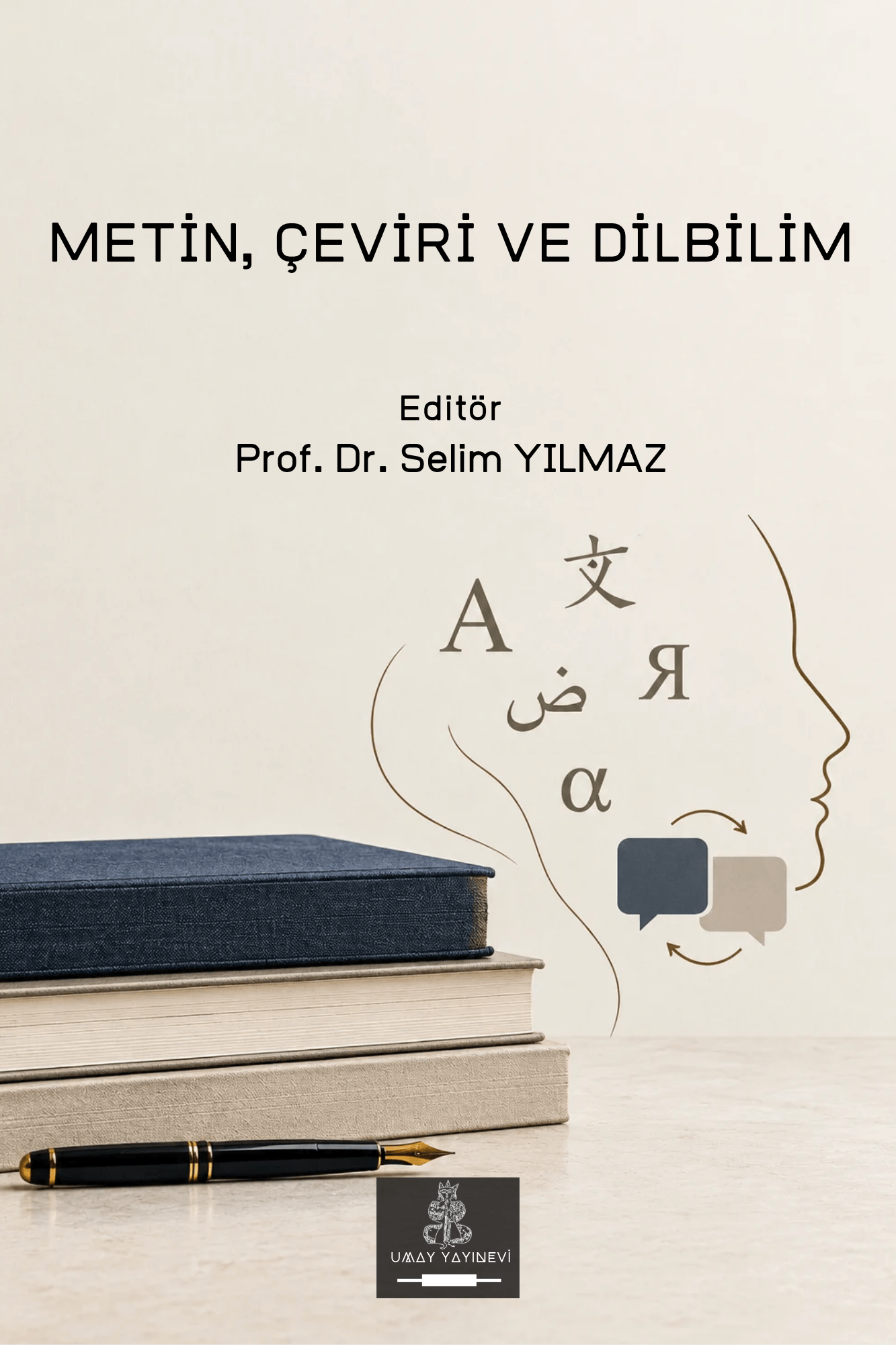
| Kitap Adı / Yazar | Metin, Çeviri ve Dilbilim / Editör: Selim Yılmaz |
| Yayın Yılı | 2026 / Umay Yayınevi |
| Sayfa Sayısı | 313 |
| Baskı Sayısı / Yer | 1. Baskı / Samsun |
| ISBN | 978-625-8950-94-6 |
| DOI | 10.5281/zenodo.23163791 |
| Dil | Türkçe |
| Ana Konular | Metinbilim, Dilbilim, Çeviribilim, Disiplinlerarası Yaklaşımlar |
| Atıf/Cite | Yılmaz, S. (Ed.) (2026). Metin, çeviri ve dilbilim. Umay Yayınevi. |
Öz:
Dil Yetisi (İng. Language, fr. Langage), insanoğlunu diğer canlılardan ayıran en önemli özelliğidir. Bu sayede insan toplumda iletişim kurar ve çevresinde kendisini ifade etme olanağına sahip olur. Konuştuğu dil ne olursa olsun insan, dil kullanımı sayesinde varlığını ortaya koymak suretiyle kendini ifade eder. Dil aynı zamanda milletlerin, ulusların da varlık sebebidir. Çeviri, dil-kültür ilişkisi bağlamında iletişimi destekleyen bir unsur, bir dilsel araç iken, Çeviribilim dil-çeviri konu ve sorunlarını irdeleyen bilim dalıdır. En genel tabiriyle, insanın kullandığı doğal dilleri, söz ve söylemleri inceleyen temel bilim dalı, Sosyal ve Beşerî Bilimlerin temel yapı taşı sayılan “Dilbilim”dir. Dilbilim alanının kurucusu ve Dilbilimin Babası olarak anılan İsviçre asıllı dilbilimci Ferdinand de Saussure’un (1965) “Genel Dilbilim Dersleri” başlıklı ölümsüz eserinde ortaya koyduğu işlevsel dilbilim kuramının temelini “Dil, Dil Yetisi, Söz” ve dili kullanan birey “Konuşan Özne” kavramları oluşturur. Bunlar aynı zamanda ilişkisel bağlamda ikili terim oluşturmak suretiyle “Dil – Dil Yetisi, Dil – Söz” gibi önemli dikotomileri kurarlar. “Metin, Çeviri ve Dilbilim” başlıklı bu kitap, dil kavramını konu alan ve onu kullanan birey ile ilişkilendirerek toplumsal kriterler çerçevesinde bağlamsal açıdan değerlendiren birbirinden değerli, ilgi uyandıran, Türkçe başta olmak üzere farklı yabancı dilleri de mercek altına alan çalışmalardan oluşur.
Abstract:
Language (Eng. Language, Fr. Langage) is the most important characteristic that distinguishes humankind from other living beings. Through language, humans communicate within society and have the ability to express themselves in their environment. Regardless of the language they speak, humans express themselves by asserting their existence through the use of language. Language is also the raison d’être of peoples and nations. While translation is an element that supports communication within the context of the language-culture relationship—a linguistic tool—translation studies is the academic discipline that examines issues and problems related to language and translation. In the broadest sense, the fundamental academic discipline that studies the natural languages, words, and discourses used by humans is “Linguistics,” considered a cornerstone of the Social and Humanities Sciences. The Swiss linguist Ferdinand de Saussure, known as the founder of linguistics and the “Father of Linguistics,” (1965), the foundation of the functionalist theory of linguistics he presented in his timeless work Course in General Linguistics is formed by the concepts of “Language, Linguistic Competence, Speech,” and the individual who uses language, the “Speaking Subject.” These concepts also establish important dichotomies—such as “Language–Language Ability” and “Language–Speech”—by forming binary pairs within a relational context. This book, titled “Text, Translation, and Linguistics,” consists of a collection of valuable and thought-provoking studies that address the concept of language, relate it to the individual who uses it, and evaluate it contextually within a framework of social criteria, focusing primarily on Turkish as well as various other foreign languages.
ÖN KAPAK İÇİN TIKLAYINIZ.
Bibliyografik kayıtlar için aşağıdaki düğmeye tıklayınız.
 TR
 EN